
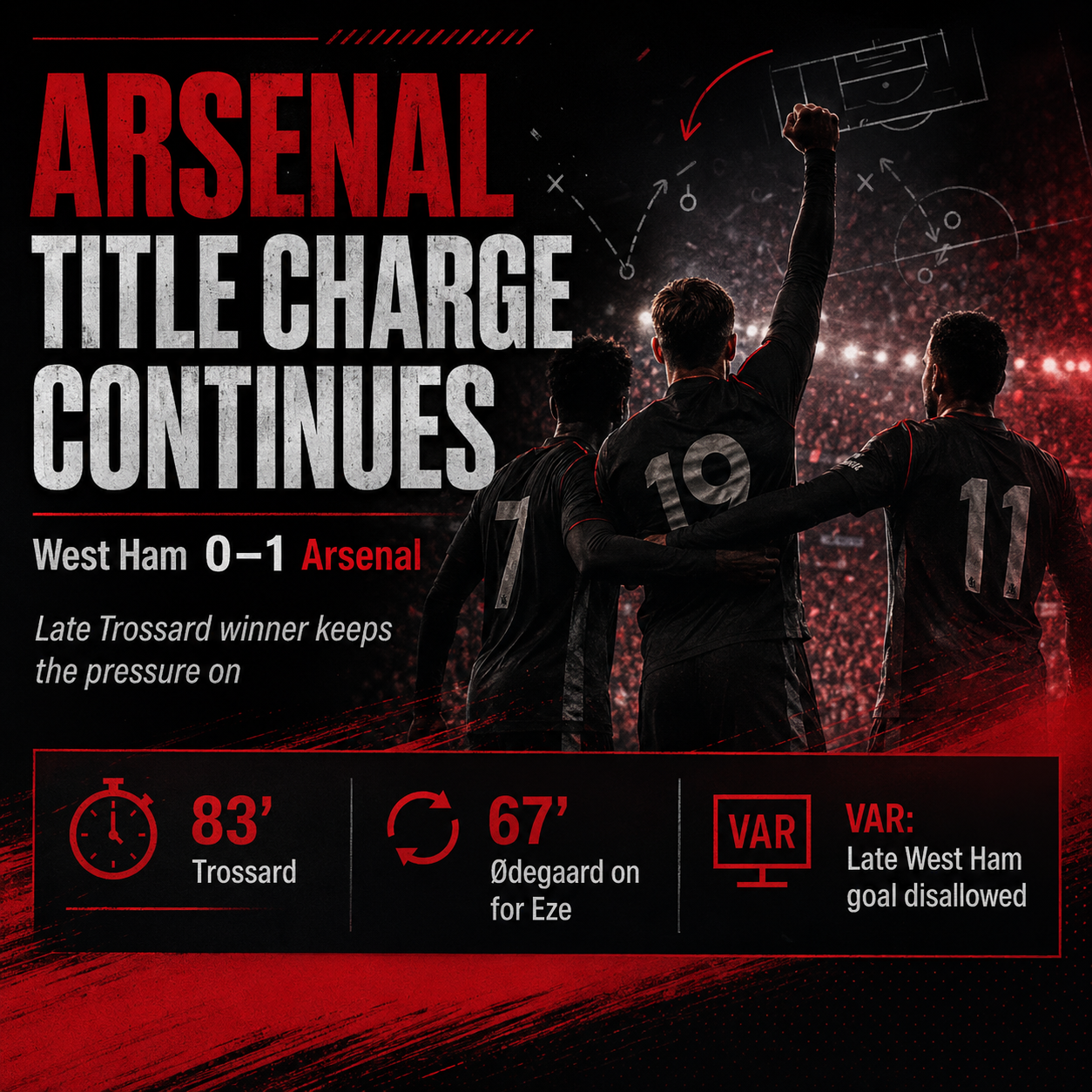
Arsenal found a way to win a tense London match. They beat West Ham United 1-0 at the London Stadium, and Leandro Trossard scored the only goal in the 83rd minute. It was not a perfect Arsenal performance, but it was the kind of result that matters in a title race.
This game looked simple on the scoreline, but it had many small details. Arsenal controlled large parts of the match. West Ham defended deep, waited for transitions, and made the second half difficult. In the end, Arsenal’s bench decision also became important.
Arsenal Title Charge Continues With Patience
The first half showed Arsenal’s main idea clearly. They wanted the ball. They wanted territory. They wanted to keep West Ham close to their own box. Arsenal had 66% possession in the first half, made 257 passes, and produced 10 shots before the break.
That pressure told a clear story. Arsenal were not only passing to keep the ball. They were trying to move West Ham from side to side. Leandro Trossard gave width and threat on the left. Bukayo Saka started on the right. Eberechi Eze played as one of Arsenal’s creative players before Martin Ødegaard came on later.
That detail is important. Ødegaard did not start the match. He came on in the 67th minute in place of Eze. So Arsenal’s winning goal was not just about one pass. It was also about a second-half change that gave Arsenal fresh control and better timing near the box.
West Ham Made Arsenal Work for Everything
West Ham deserve credit for making the match uncomfortable. Konstantinos Mavropanos was named Player of the Match with an 8.4 rating. That says a lot about the game. When a centre-back receives the highest rating in a 1-0 defeat, it usually means his team had to defend many dangerous moments.
Mavropanos helped West Ham survive long spells of pressure. Jean-Clair Todibo, Axel Disasi, and the wing-backs also had to handle Arsenal’s wide attacks. West Ham did not give Arsenal many easy chances through the middle. They forced Arsenal to recycle possession and keep searching for the right angle.
The second half changed the rhythm. West Ham became more dangerous. They had 1.19 expected goals after the break, while Arsenal had 0.55. West Ham also had six shots in the second half, one big chance, and three corners. That made the final stage tense for Arsenal.
Ødegaard’s Substitution Changed the Final Third
The 67th-minute change mattered. Eze went off, and Ødegaard came on. Arsenal needed more calm and cleaner decisions around the penalty area. Ødegaard gave them that. He did not need many minutes to affect the game. He needed one right moment.
In the 83rd minute, that moment arrived. Ødegaard assisted Trossard, who scored with a right-footed shot from the centre of the box. It was the kind of goal that comes from patience. Arsenal did not panic when West Ham blocked earlier attacks. They kept their shape, kept pushing, and trusted the players who could decide the match.
This is why small details matter in analysis. A substitution is not only a name change. It can change the rhythm, the passing angles, and the final pass. Ødegaard’s arrival helped Arsenal find the quality they needed late in the game.
A Critical Win for Arsenal’s Title Push
Arsenal title charge continues because they found a result when the match became difficult. This was not a flashy win. It was a serious one. Arsenal had to suffer late, especially after West Ham improved in the second half.
They also had to manage the emotional side of the match. Saka, Mosquera, Saliba, and Trossard all received yellow cards in the second half. West Ham sent on Callum Wilson late and thought they had equalised in stoppage time, but VAR cancelled the goal. That made the final whistle feel even bigger for Arsenal.
At this stage of a title race, away wins like this can carry huge value. Arsenal controlled the first half, survived West Ham’s second-half push, and then used their bench to find the key moment. Trossard finished the chance. Ødegaard supplied the assist. The defence held firm when it mattered.
For Arsenal, this 1-0 win was about more than three points. It was about control, pressure, patience, and timing. In matches like this, the small details can decide the biggest stories.