
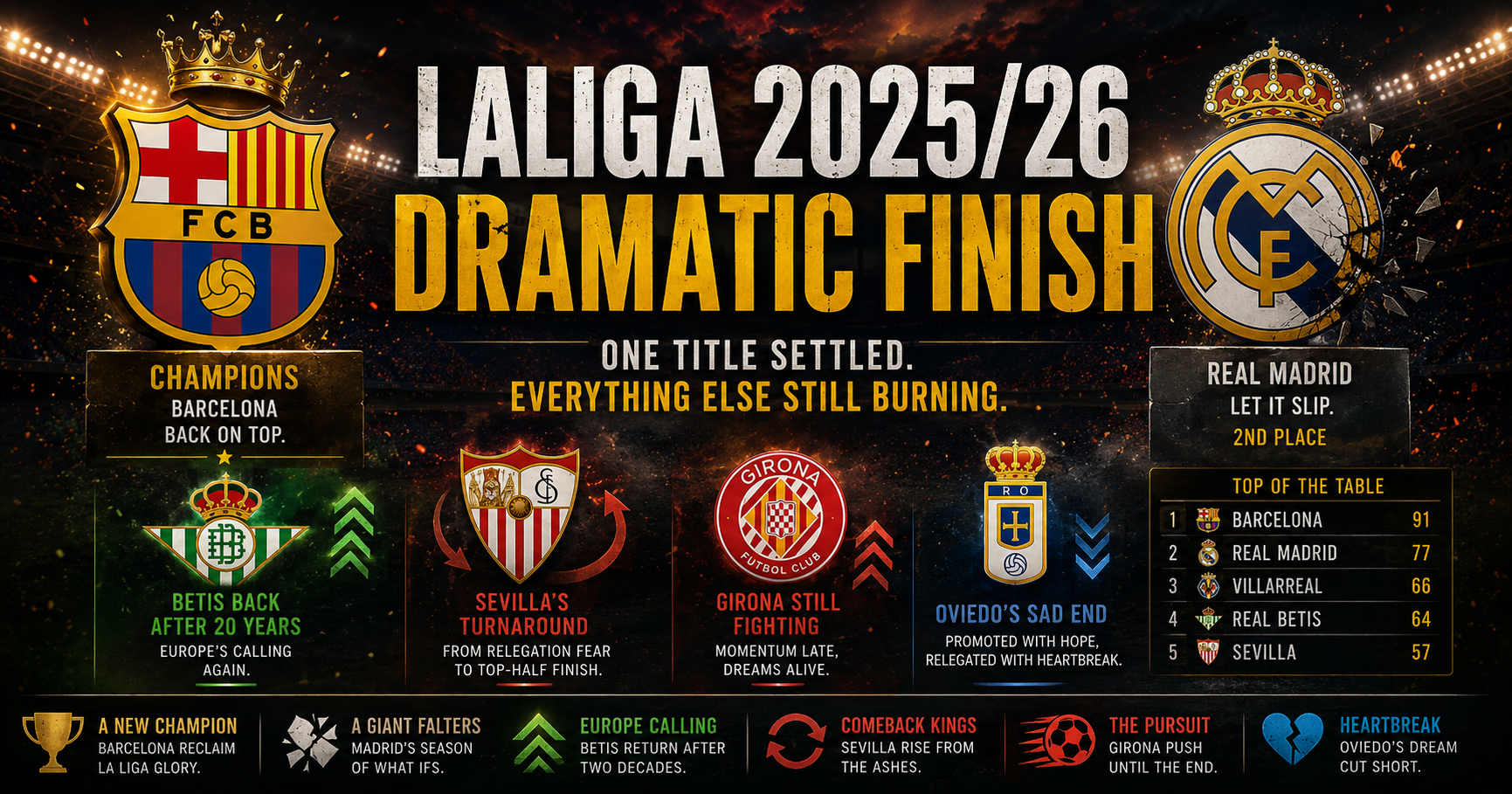
Look at the table for a second. Really look at it.
Barcelona at the top, lifting another trophy after that 2-0 win over Real Madrid at Camp Nou. The headline writes itself. Done. Wrapped. Hansi Flick’s second straight LaLiga title in two years, secured with three matches still to play.
But scroll down. That’s where the actual story lives.
From 11th place all the way down to 19th, the gap is five points. Five. Nine teams squeezed into that little corridor, all of them either chasing Europe or running from the trapdoor, and most of them doing both at once depending on the weekend. In most leagues, by mid-May, the bottom half has already accepted its fate. Players are mentally on the beach. Coaches are quietly updating LinkedIn. But not here. Not this season.
Here’s the thing. This season had everything. A perfect start that turned into a collapse. A team left for dead in October that’s still alive in May. A 20-year European drought broken. A returning hero relegated before he could write his last chapter. Let me walk you through it.
The Champion: Barcelona, Almost Too Easy
Let’s get this out of the way quickly, because honestly, the champions aren’t the most interesting story this year.
Barcelona did what they had to do. They won when it mattered, they smashed Madrid 2-0 at Camp Nou on May 10 to seal the title, and Lamine Yamal continued his march toward becoming the most-talked-about footballer on the planet. Marcus Rashford’s loan move from Manchester United, which everyone mocked over the summer, ended up paying off. The kid scored the free kick that all but ended the title race.
Flick now has back-to-back LaLiga titles. Eleven straight league wins in his current streak. He joins Guardiola, Rijkaard, Luis Enrique, and Tito Vilanova as the only Barcelona managers to hit that mark. That’s the company he’s keeping now. Make of that what you will.
But the real story isn’t that Barcelona won. It’s that for the first half of the season, it really, really looked like they wouldn’t.
The Collapse: How Real Madrid Lost a Title They Already Had
Rewind to September. Xabi Alonso, Madrid’s golden boy manager, had just done something nobody had managed in 20 years.
Six matches. Six wins. Eighteen points from a possible eighteen. Alonso equaled a record set by Vanderlei Luxemburgo back in 2005 as the only coaches in LaLiga history to start a season with a perfect record through six rounds. Madrid looked unstoppable. Mbappé was scoring for fun. Bellingham was running the show. The Bernabéu was loud and confident.
Then came the Clásico on October 26. Madrid won 2-1. Mbappé opened the scoring, Bellingham got the winner just before halftime. The win pushed Madrid five points clear at the top of LaLiga after ten matchdays. Five points. In late October. With Barcelona already looking shaky in defense and missing key players. The title was, honestly, theirs to lose.
So they lost it.
What actually went wrong
Slowly at first. A draw against Girona. A defeat against Celta at home that genuinely embarrassed them. By Christmas, Barcelona had quietly retaken the top spot with a four-point lead despite having lost the Clásico. Spain went into the winter break talking about Barça as “Christmas champions” while Madrid wondered what just happened.
Madrid did fight back. In February, an eight-match winning streak briefly put them back on top after a 4-1 dismantling of Real Sociedad on Valentine’s Day. But then the wheels came off again. Over their next nine matches, they won only four. Barcelona won all nine of theirs. The gap stretched, then snapped.
The lowest point came at the end of March when Madrid lost away at relegation-threatened Mallorca. Álvaro Arbeloa, who had replaced Alonso as head coach mid-season, took full blame in the press conference. By then, the title race was effectively done.
Eleven points behind. A mid-season managerial change. A perfect September that meant absolutely nothing by April. That’s not a Real Madrid season. That’s a case study.
The Quiet Excellence: Villarreal Just Keep Showing Up
Now let me tell you the opposite story. The team that just… showed up. Every week. No drama. No headlines. Just three points, three points, three points.
Marcelino’s Villarreal aren’t sexy. They don’t have a magical 17-year-old or a billionaire owner doing stupid things. They just play football. Properly.
Look at them on the table: 36 played, 21 wins, 6 draws, 9 losses, 69 points. Third place. Champions League sealed. They beat the teams they should beat, they nick points off the big ones, and they go home. That’s it. That’s the whole show.
Why Villarreal matters
In a season where so many mid-table clubs lurched from crisis to mini-revival to crisis again, Villarreal just stayed Villarreal. That’s harder than it sounds. Real Sociedad couldn’t manage it. Athletic Club couldn’t manage it. Both Madrid clubs had their wobbles. Even Atlético, who you’d think were built for grind-it-out consistency, sit fourth at 66 points and lost matches they shouldn’t have. Villarreal didn’t.
They lost just once at home all season, and that was to Barcelona. One loss. At home. In nine months of football. That’s championship-level consistency from a club operating on a fraction of the budget the top two have.
If you want to know what a well-run football club looks like in 2026, stop staring at Camp Nou. Stare at the Estadio de la Cerámica.
The Comeback After 20 Years: Pellegrini’s Real Betis
Worth pausing here for Real Betis, because what they’ve done is genuinely special, even if nobody outside Seville is talking about it loudly enough.
Champions League. After 20 years. Real Betis are heading back to Europe’s top competition for the first time since 2005-06. Twenty years of watching other clubs play those Tuesday and Wednesday night games while you settle for Europa League and Conference League scraps. That’s over.
Look at their numbers though. Fifteen draws. Fifteen. They’ve won 14, drawn 15, lost 7. Betis don’t blow you away. They draw you, they wear you down, they nick you 1-0, they go home. Manuel Pellegrini is 72 years old and he’s built a team that plays like a chess grandmaster running down the clock.
“It’s not easy to be in European competitions for six years,” Pellegrini said after sealing the spot. “Much less to have qualified for the Champions League two matches before the end of the season.”
The Engineer, they call him in Seville. After this season, you understand why.
The Comeback of the Year: Girona’s Refusal to Die
This is the one. The story that should be a Netflix documentary by next summer.
You probably remember Girona as the fairytale team. The little Catalan club that finished third two seasons ago, made the Champions League, and then promptly lost every important player they had. Dovbyk went to Roma. Savinho to Manchester City. Aleix García to Leverkusen. Eric García back to Barcelona. The replacements didn’t work out.
The October nightmare
This season started exactly the way you’d fear. After nine matches, Girona had six points. Six. One win. Worst goal difference in the league. Bottom of the table. They’d picked up just three wins in their last 26 LaLiga matches stretching back into the previous season.
That’s not a slump. That’s a death spiral. By October, every neutral was already writing the obituary. Champions League to Segunda in 18 months. Brutal symmetry. Football’s cruelest punchline.
The slow climb back
And then, somehow, they started clawing.
Not gracefully. Not with a flowing system or a star striker suddenly finding form. Just ugly, late, gritted-teeth points. Cristhian Stuani, a 38-year-old veteran who probably can’t run more than 15 minutes at a time, kept coming off the bench and refusing to let his team die. That draw against Rayo Vallecano on matchday 35? Vintage Stuani. Came on, won a header in the 90th minute, gave Girona the point they desperately needed. The kind of goal that ages goalkeepers ten years.
They’re not safe yet. They sit 18th going into the final stretch, two points above the drop. But to even be in this conversation, to have a fighting chance after starting the season with six points from nine games, is genuinely remarkable.
If they pull this off, somebody at Montilivi needs to commission a statue of that old Uruguayan.
The Fallen Giant: Sevilla on the Edge
Quick reality check. Sevilla are a seven-time Europa League winner. They’ve lifted that trophy more than anyone in history. They beat Manchester United and Inter Milan in finals. They have a trophy room that most “bigger” clubs would kill for.
And on the final weekend of the 2025/26 season, they’re sweating relegation.
How did it get here? A summer of chaos. Financial restrictions. Squad turnover. A coaching change mid-season when Matías Almeyda was replaced by Luis García Plaza. They’ve been one bad weekend from the drop zone for months now.
That win over Espanyol on matchday 35 probably saved them. Probably. With 43 points and three games left, they’re not mathematically safe. Sevilla. Not mathematically safe. Read that sentence again. It still doesn’t feel real.
This is what happens when a big club loses the plot. Not in one season. In several. Decades of mismanagement and short-term thinking finally catching up. The trophy cabinet is still gold-plated, but the league position is gutter-level.
The Tragedy: Real Oviedo’s Lost Year
Real Oviedo. Bless them.
Twenty-four years out of the top flight. They came up through the playoffs last summer on a tide of emotion, with Santi Cazorla coming home like a returning king to play the last chapter of his career. The Carlos Tartiere was rocking. Asturias was alive. Football romantics everywhere had picked Oviedo as their second team for the season.
Then the season actually started.
Three managers, zero stability
Veljko Paunović, the man who got them promoted, lasted eight matches. Eight. Luis Carrión came in and made things worse. Guillermo Almada arrived in December and stabilized things slightly but couldn’t manufacture the wins they needed.
Three managers in one season. That’s not a coaching problem. That’s an institutional one.
The numbers tell the story. Six wins in 35 matches. Eleven draws. Eighteen defeats. Twenty-six goals scored. They averaged 0.74 goals per game in the most goal-friendly league in Europe. You simply cannot survive scoring that little.
On matchday 35, Oviedo became the first team mathematically relegated from LaLiga 2025/26. A goalless draw between Rayo and Girona, courtesy of yet another Stuani goal in stoppage time, sealed their fate.
Cazorla’s farewell
The cruelest part isn’t the relegation. It’s that the relegation was inevitable from about November. Cazorla, the local boy who came home to play in front of his people, will likely retire watching his club drop back into Segunda. He’s hinted he may have played his last games.
“We have many lessons to learn from this season,” he said recently. “Regarding club decisions, management, and the importance of everyone pulling together.”
Football can be merciless. Oviedo learned that all over again.
What’s Still at Stake
Now to the part that’s going to keep Spanish football fans awake this week.
Two relegation spots remain open. Oviedo are gone. The other two go from a pool of about seven teams. Levante on 39, Alavés on 37, Girona on 39, Mallorca on 39, Espanyol on 42, Elche on 39. Even Sevilla at 43 can’t fully relax. One bad weekend can flip everything.
Then there’s the European race, which is somehow just as tangled. Celta are sitting pretty in 6th with 50 points, but Getafe at 45 are right there for Europa. Real Sociedad winning the Copa del Rey complicates things further. If they finish in the top six, the Europa League spot passes down to seventh. If they finish top seven, the Conference League spot moves to eighth. Got that? Good, because nobody else has either.
What that means in plain language: one or two results across the next three weekends will completely rearrange who plays European football next year and who plays Castellón in Segunda. A team like Osasuna, sitting 11th, is genuinely three points from a European spot and three points from a relegation fight at the same time. Pick a direction.
The Final Word
Here’s what this season really tells us.
Barcelona winning the title with three games to spare made it look like a one-horse race. It wasn’t. It really wasn’t. Below the top two, this has been one of the most evenly matched, unpredictable LaLiga seasons in years. A club that played Champions League football 24 months ago is fighting for its life. A club that hasn’t sniffed the Champions League in two decades just qualified for it. Real Madrid started 6-0-0 and finished 11 points behind. A team came up dreaming and is going back down without ever waking up.
And we still have three matchdays left.
If you’re a neutral, this is the good stuff. Forget the title race. Watch the bottom seven. Watch Girona try to finish what they started in November. Watch Sevilla try not to make history of the worst kind. Watch Espanyol and Mallorca and Alavés play three games each that mean more to their fans than any El Clásico ever could.
The trophy is in Catalonia. The drama is everywhere else.